


Is Exosome Therapy Better Than PRP for Hair Regrowth?
August 12, 2026
Can Ozempic Cause Muscle Loss Along With Fat Loss?
September 10, 2026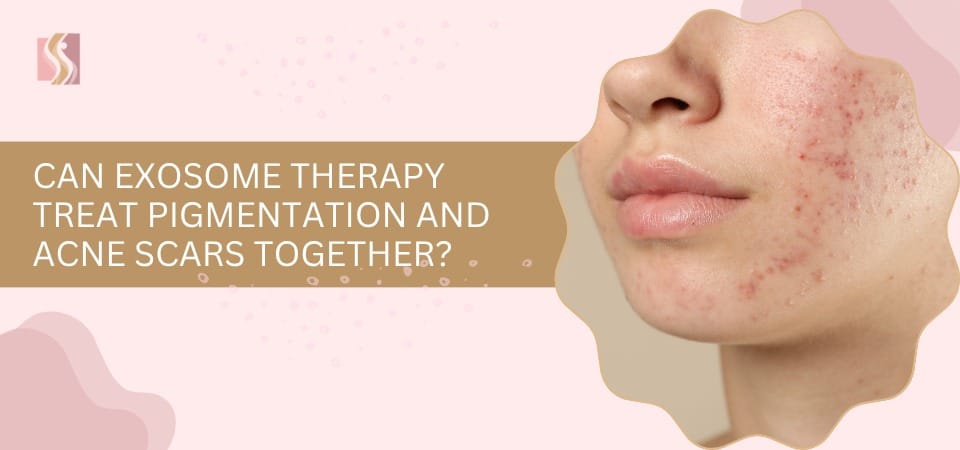
Exosome therapy uses lab-purified cell messengers to speed up your skin’s own repair process. Delivered into the mid-dermis, they calm excess pigment production and push collagen-producing cells into higher gear, both at once. Two concerns, one mechanism. So instead of splitting treatment into two separate plans, one protocol can realistically take on pigmentation and acne scarring together. Most patients need 3 to 4 sessions, spaced 3 to 4 weeks apart, with texture improving first and tone evening out not long after.
According to Dr. Anju Methil, dermatologist in Andheri, “Pigmentation and acne scars both come from the same disrupted repair signalling in the skin. Exosomes work directly on that signalling instead of chasing each symptom separately. That’s the real reason a combined protocol holds up clinically, and it isn’t just a convenient way to sell two treatments as one.”
What Does Exosome Therapy Actually Do for Skin?
Exosomes are tiny vesicles that cells release to communicate with their neighbours. Delivered through microneedling, they amplify repair signalling that’s already happening in the skin, just faster and more concentrated.
- Cell-to-Cell Signalling: Each exosome carries growth factors and regulatory proteins. These instruct nearby cells to repair faster, using a pathway the skin already relies on.
- Effect on Pigmentation: Melanin production settles down, anti-inflammatory signals target what’s triggering it, and cell turnover evens out so discoloured patches fade uniformly rather than in blotches.
- Effect on Acne Scars: Fibroblasts, the cells responsible for collagen, get pushed into higher activity. Depressed, uneven texture starts filling in from underneath instead of just being smoothed on the surface.
- Why Both Respond to the Same Mechanism: Pigmentation and scarring both trace back to disrupted cellular repair. Work on that repair process directly, and you’re addressing both at once, not treating them as separate problems that happen to share a face.
In practice, patients rarely experience these as two separate issues anyway. Dark spots and uneven texture tend to show up together. That’s exactly why treating them as one concern holds up clinically.
For patients whose main concern is discolouration, our pigmentation treatment page covers the full range of options available at the clinic.
Wondering if a combined exosome protocol could work for your skin?
Can One Treatment Really Target Both at the Same Time?
This is the question most patients actually want answered. And the honest answer is yes, but the plan has to be built around your specific skin.
- Combined Protocol: Exosomes reach the mid-dermis through microneedling, right where pigment-producing cells and collagen-producing fibroblasts both sit. One pass, both layers.
- Session Timeline: Most plans run 3 to 4 sessions, spaced 3 to 4 weeks apart, though scar depth and how long the pigmentation has persisted can shift that.
- What Results Look Like: Texture improves first. Tone follows a few weeks behind, as pigment turnover normalises.
- Combining With Other Treatments: Chemical peels or standalone microneedling sessions sometimes get layered in, depending on how the skin responds during the protocol, a decision made during consultation, not fixed in advance.
The protocol is built around the skin’s response, not a preset formula.
For patients exploring options before committing to a clinical protocol, our blog on how to remove acne scars from face naturally is worth reading first.
Why Choose Dr. Anju Methil for Exosome Therapy?
Dr. Anju Methil, founder of Skin and Shape Clinic, has over 29 years of clinical experience and holds active memberships in IADVL, IMA, and CDSI. Before starting any exosome protocol, she personally assesses skin type, scar depth, and pigmentation pattern to decide on session count, delivery depth, and whether a complementary treatment is needed.
Her approach is built on individual assessment, not a fixed template. Two patients with similar-looking pigmentation can still end up on different treatment plans, because their scar depth or skin response isn’t the same. Genuine, clinic-sourced exosome products are used throughout, under direct medical supervision. Call +91 8779911797 to book your consultation.
FAQs
Is exosome therapy painful? Not really. Most patients describe mild pressure during the microneedling itself, and a numbing cream goes on first, so the session stays comfortable rather than sore.
How many sessions are needed to treat both concerns? Usually 3 to 4 sessions, spaced about 3 to 4 weeks apart. That number can move a bit depending on scar depth and how long the pigmentation has been sitting there.
Is exosome therapy safe for all skin types? It is. Exosomes are biocompatible and tend to be well tolerated across skin types, sensitive and acne-prone skin included.
Can exosome therapy be combined with other treatments? It can, and often is. Microneedling and chemical peels get layered in sometimes, depending on how the skin is responding through the protocol.
How soon will I see results? Texture usually shifts first, somewhere around the second or third session. Pigmentation takes a little longer, evening out gradually as skin turnover continues.
References
- PMC: Treatment of Postinflammatory Hyperpigmentation Following Acne With Microneedling and Panax Ginseng-Derived Exosomes: https://pmc.ncbi.nlm.nih.gov/articles/PMC12266880/
- PMC: Combination Treatment with Human Adipose Tissue Stem Cell-derived Exosomes and Fractional CO2 Laser for Acne Scars (Acta Dermato-Venereologica): https://pmc.ncbi.nlm.nih.gov/articles/PMC9309822/
Disclaimer: This blog is for informational and educational purposes only. If you’re considering exosome therapy, consult a qualified dermatologist to determine whether it’s suitable for your skin type and concerns.
